
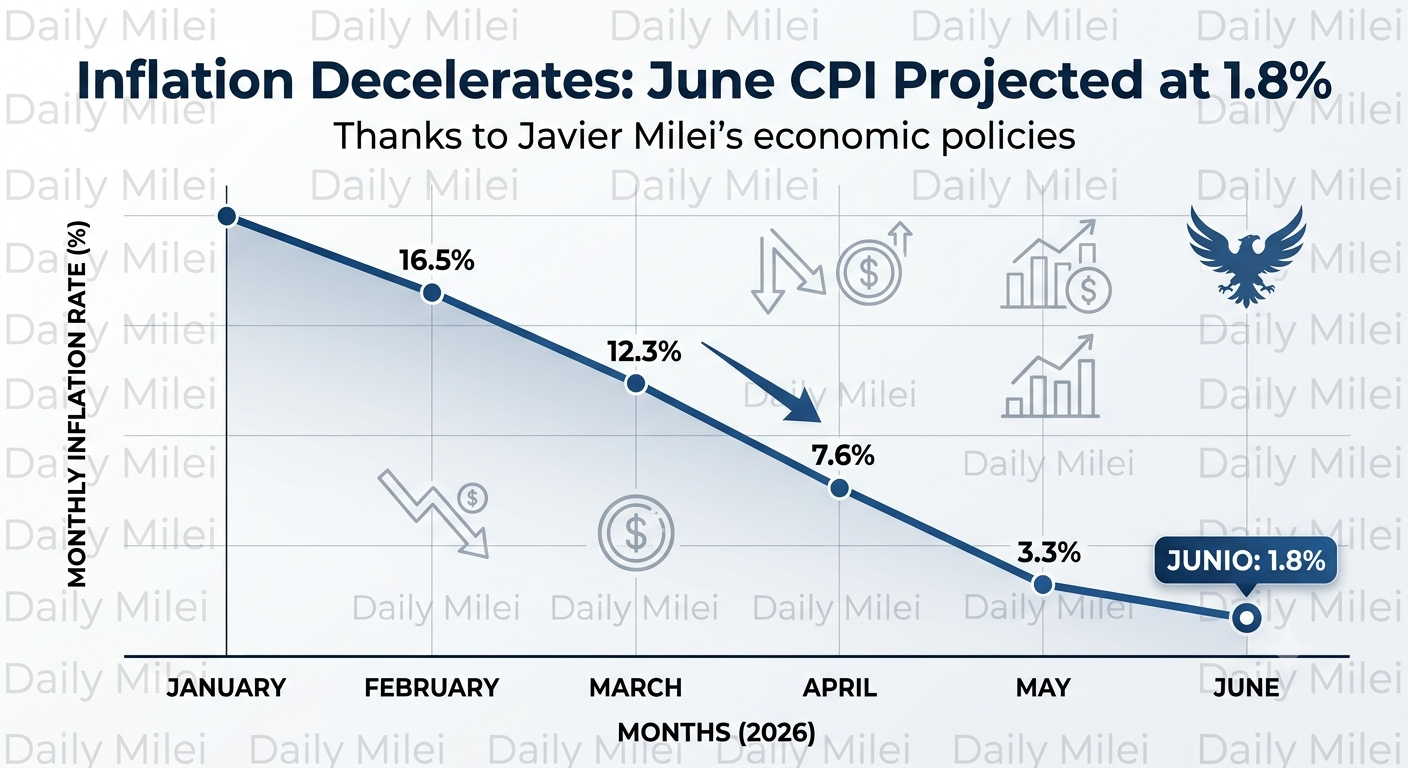
The latest economic data for June 2026 confirms a sustained downward trend in consumer prices. According to the most recent monitoring by leading private consultancies, the monthly Consumer Price Index (CPI) is projected to close at approximately 1.8%. This marks a significant milestone in the administration’s battle to bring price stability to the Argentine economy, reflecting a continued easing of inflationary pressures in the final week of the month.
The deceleration is being driven by a combination of strict fiscal discipline, the normalization of monetary policy, and the steady stabilization of the exchange rate. For consumers and businesses alike, this trend is a vital indicator that the “normalization phase” of the economy is yielding tangible results, reducing the uncertainty that has historically plagued the national marketplace.
Factors Behind the Deceleration
The contraction in the inflation rate is the result of several key policy pillars that the government has consistently maintained since taking office:
-
Fiscal Surplus: The commitment to a primary fiscal surplus has effectively removed the government’s reliance on money printing to cover deficit spending, addressing the root cause of domestic inflation.
-
Exchange Rate Stability: The narrowing gap between official and parallel exchange rates has significantly dampened the pass-through effects of currency devaluation on domestic prices.
-
Rationalized Public Spending: By eliminating subsidies that once distorted market prices, the economy is shifting toward a model of real cost, which, while initially painful, has led to a more stable and predictable pricing structure.
-
Monetary Prudence: The Central Bank’s focus on cleaning up its balance sheet and managing the monetary base has restored confidence in the peso, encouraging individuals to save and invest rather than simply fleeing to hard currency.
What This Means for the Second Half of 2026
The projection of 1.8% for June is being viewed by analysts as a crucial benchmark. As the economy moves into the second half of the year, the focus will shift from “crisis management” to “structural growth.” With inflation approaching levels not seen in years, the government aims to encourage a return of consumer purchasing power—not through artificial wage hikes, but through the natural stabilization of prices and the growth of productive capacity.
While the administration remains cautious, emphasizing that there is still much work to be done to achieve full monetary stability, the consistent downward trend in the CPI is the strongest proof yet that the “chainsaw” and “blender” strategies are effectively reining in the runaway prices that defined previous administrations. As price predictability returns, the climate for medium- and long-term investment is expected to improve significantly.
Stay informed as we track the monthly inflation metrics and the ongoing normalization of Argentina’s economy.








Leave A Comment